
Prague Castle History — From Bořivoj to the Czech Republic
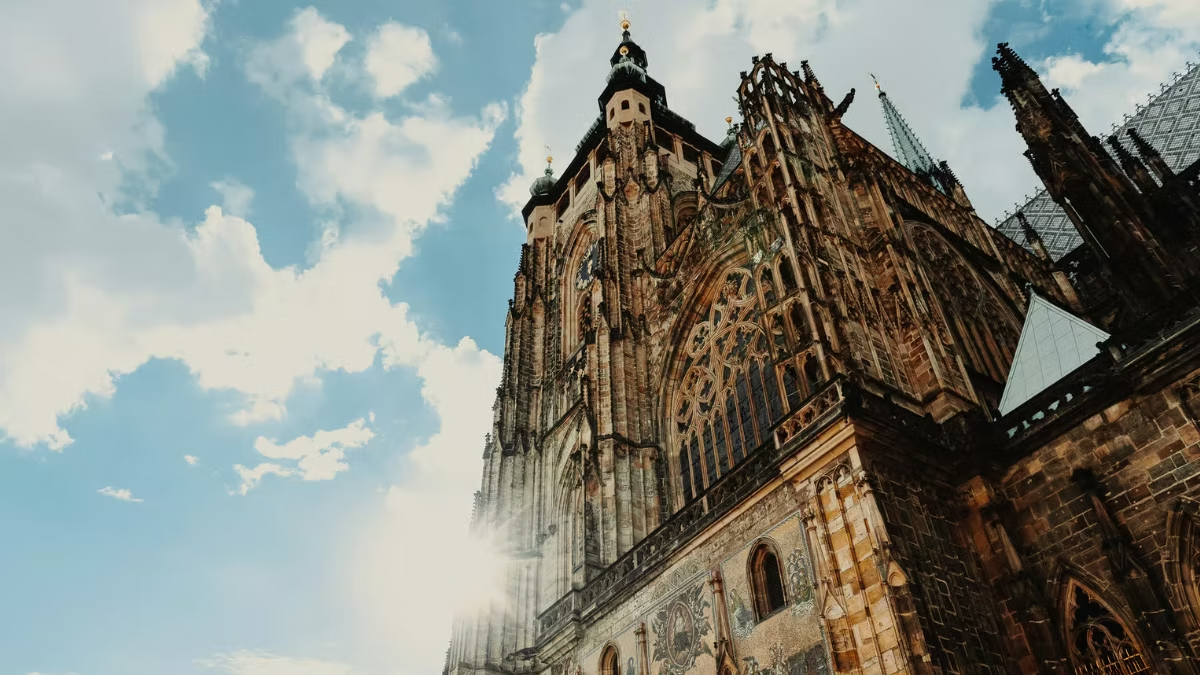
Prague Castle has been continuously inhabited and used as a seat of power for over 1,100 years — longer than any other castle complex on earth. Understanding even a fraction of its history makes a visit dramatically more rewarding: the bare stone rooms of the Old Royal Palace become the settings for medieval coronations, political crises, and world-changing events; the cathedral becomes a 600-year project measuring the ambitions of an empire.
This article provides a chronological overview of the castle’s history from its founding to the present day.
Founding: The Přemyslids (c.880–1306)
Prague Castle was founded around 880 AD by Prince Bořivoj, the first historically documented member of the Přemyslid dynasty. The first walled building was the Church of the Virgin Mary. The Basilica of St. George and a predecessor rotunda to St. Vitus Cathedral were both founded in the first half of the 10th century. From the beginning, the castle served as both the seat of the Bohemian prince and the centre of church authority.
Prince Bořivoj moved his residence from Levý Hradec — north of Prague — to the hilltop above the Vltava River, where a Slavic settlement already existed. The location was strategic: commanding views over the river valley, naturally defended by the deep Deer Moat ravine on the north side, and positioned at the centre of the Bohemian territories.
The first stone building was the Church of the Virgin Mary. Archaeological remains are visible beneath the Second Courtyard. Shortly after, Prince Vratislaus I founded the Basilica of St. George (c.920), whose Romanesque core still stands as the oldest surviving church at the castle. His son, Prince Václav I (St. Wenceslas), founded a small rotunda on the site where St. Vitus Cathedral stands today.
In 973, Prague Castle became the seat of the first Bishop of Prague, cementing its dual role as the centre of both secular and religious power in Bohemia.
Charles IV and the Gothic Peak (1346–1378)
The greatest period of construction at Prague Castle was under Emperor Charles IV (Karel IV), who became King of Bohemia in 1346 and Holy Roman Emperor in 1355. Charles IV rebuilt the Royal Palace, strengthened the fortifications, and in 1344 ordered the construction of Gothic St. Vitus Cathedral on the model of the great French Gothic cathedrals. His reign represented Prague Castle’s first peak as a centre of European power.
Charles IV was arguably the most important ruler in Czech history. Under his governance, Prague became the seat of the Holy Roman Empire — one of the most powerful political entities in Europe — and the castle its showpiece. He enlarged and rebuilt the Royal Palace, initiated the construction of St. Vitus Cathedral under architects Matthias of Arras and then Peter Parler, and created a complex worthy of imperial residence.
The cathedral’s chancel and south tower were largely completed under Parler. The Gothic style — flying buttresses, pointed vaults, elaborate tracery — was modelled on the cathedrals of Reims and Cologne. Charles IV himself is buried in the royal crypt beneath the cathedral.
Rudolf II and the Renaissance Court (1576–1611)
Emperor Rudolf II made Prague Castle his permanent residence and transformed it into one of the great intellectual and artistic centres of Renaissance Europe. He employed astronomers Tycho Brahe and Johannes Kepler, assembled one of the greatest art collections of his era, and patronised alchemists, scientists, and artists from across Europe.
Rudolf II’s Prague was a city of curiosities — a court that attracted the era’s greatest minds and charlatans in equal measure. The emperor was genuinely obsessed with science, art, and the occult. He founded the Spanish Hall in the northern wing of the palace to house his art collections, and transformed the castle into a cultural capital to rival Rome, Venice, and Vienna.
Much of Rudolf’s collection was looted by Swedish forces during the Battle of Prague in 1648 — the final act of the Thirty Years’ War, which had been triggered by the Defenestration of Prague in this very castle in 1618.
The Defenestration of Prague (1618)
On 23 May 1618, Protestant Czech nobles threw two Catholic imperial governors and their secretary from a window of the Old Royal Palace. They survived (falling approximately 17 metres into a midden). The act triggered the Bohemian Revolt, which became the Thirty Years’ War (1618–1648), killing an estimated 8 million people across Europe. The room is still part of the Main Circuit.
The Defenestration — the third such incident at Prague Castle — was the culmination of mounting tension between Protestant Bohemian nobles and the Catholic Habsburg Emperor. When two royal governors closed Protestant churches in violation of the Letter of Majesty, Protestant nobles put them on trial and then threw them from the window of the Bohemian Chancellery in the Old Royal Palace.
The English word “defenestration” derives from this event. The room where it happened is accessible with the Main Circuit ticket. Most visitors walk through it without realising its significance.
Empress Maria Theresa and the Baroque Transformation (18th century)
The last major rebuilding of Prague Castle was carried out by Empress Maria Theresa in the second half of the 18th century, transforming it into a unified Baroque and Classicist ensemble. The characteristic grey-white uniform facades that give the castle its current appearance date largely from this period.
After the Habsburg capital moved permanently to Vienna, Prague Castle fell into neglect — used occasionally by visiting rulers but no longer maintained as the primary imperial residence. Maria Theresa’s renovation in the 1760s–70s created the unified visual character still visible today: the long, regular, grey-white facades along the Third Courtyard and the main circuit. The renovation was carried out by court architect Nicola Pacassi.
Walking the Main Circuit with a guide who can explain which facade dates from which era — and which rooms saw which events — turns the castle’s layered history into something vivid and concrete.
St. Vitus Cathedral Completed (1929)
Construction of St. Vitus Cathedral began in 1344 under Charles IV. It was never fully completed under any single ruler — interrupted by the Hussite Wars, the Thirty Years’ War, and centuries of neglect. Construction resumed seriously in the 19th century under the Association for Completing St. Vitus Cathedral. The western facade, nave, and rose window were finished under architect Josef Mocker and Kamil Hilbert. The cathedral was officially completed and consecrated on 28 September 1929 — the feast day of St. Wenceslas and the 1,000th anniversary of his death. Total construction time: approximately 585 years.
First Czechoslovak Republic and Plečnik (1918–1938)
When Czechoslovakia became independent in 1918, Prague Castle became the seat of its first president, Tomáš Garrigue Masaryk. Masaryk commissioned Slovenian architect Josip Plečnik to carry out a thoughtful modernisation of the castle grounds, creating the courtyards and gardens in their current form and adding distinctive design elements throughout the complex.
Masaryk’s presidency transformed Prague Castle from an austere Habsburg residence into the public seat of a democratic republic. Plečnik’s modifications — the monumental staircases and fountains in the First and Third Courtyards, the granite obelisk, the South Gardens’ current terraced form, the Fourth Courtyard redesign — brought a distinctive modernist sensibility that harmonises with the historic buildings without imitating them.
Nazi Occupation (1939–1945)
On 15 March 1939, Adolf Hitler entered Prague Castle following the forced surrender of Czech president Emil Hácha and spent the night there, “proudly surveying his new possession.” During the occupation, Prague Castle served as the headquarters of Reinhard Heydrich, the Reich Protector of Bohemia and Moravia. According to persistent legend, Heydrich placed the Crown of St. Wenceslas on his head — an act said to doom any usurper to death within a year. Heydrich was assassinated by Czech and Slovak paratroopers in May 1942. He died eight days later from his wounds.
Communist Czechoslovakia (1948–1989)
After the Communist coup of February 1948, Prague Castle became the seat of the communist Czechoslovak government and was largely closed to the public. The complex was maintained but access was severely restricted.
Post-1989: A Democratic Seat
Following the Velvet Revolution of November 1989, Václav Havel — playwright, dissident, and the revolution’s moral leader — became president and moved into Prague Castle. Havel symbolically opened the castle to the public and commissioned artist and designer Bořek Šípek to redesign certain interior spaces in a contemporary style. Prague Castle became part of UNESCO’s World Heritage listing for the Historic Centre of Prague in 1992.
Today
Prague Castle is today simultaneously the world’s most visited ancient castle complex (2.59 million visitors in 2024), the official office and ceremonial residence of the Czech President, and a functioning national cultural institution hosting concerts, exhibitions, and state ceremonies. President Petr Pavel has served since 2023. The castle remains, as it has been for over 1,100 years, the symbolic heart of the Czech state.
Frequently Asked Questions
When was Prague Castle founded?
Around 880 AD by Prince Bořivoj of the Přemyslid dynasty.
Who built Prague Castle?
No single builder — it was constructed, expanded, and rebuilt continuously over eleven centuries. Key rulers who shaped it include Prince Bořivoj (founder), Charles IV (Gothic rebuild), Rudolf II (Renaissance court), and Empress Maria Theresa (Baroque unification).
What is the most significant historical event at Prague Castle?
The Defenestration of Prague (1618), which triggered the Thirty Years’ War — one of the most destructive conflicts in European history.
Who lives at Prague Castle today?
The President of the Czech Republic. As of 2026, President Petr Pavel.
