
Prague Castle Gardens — Complete Visitor Guide
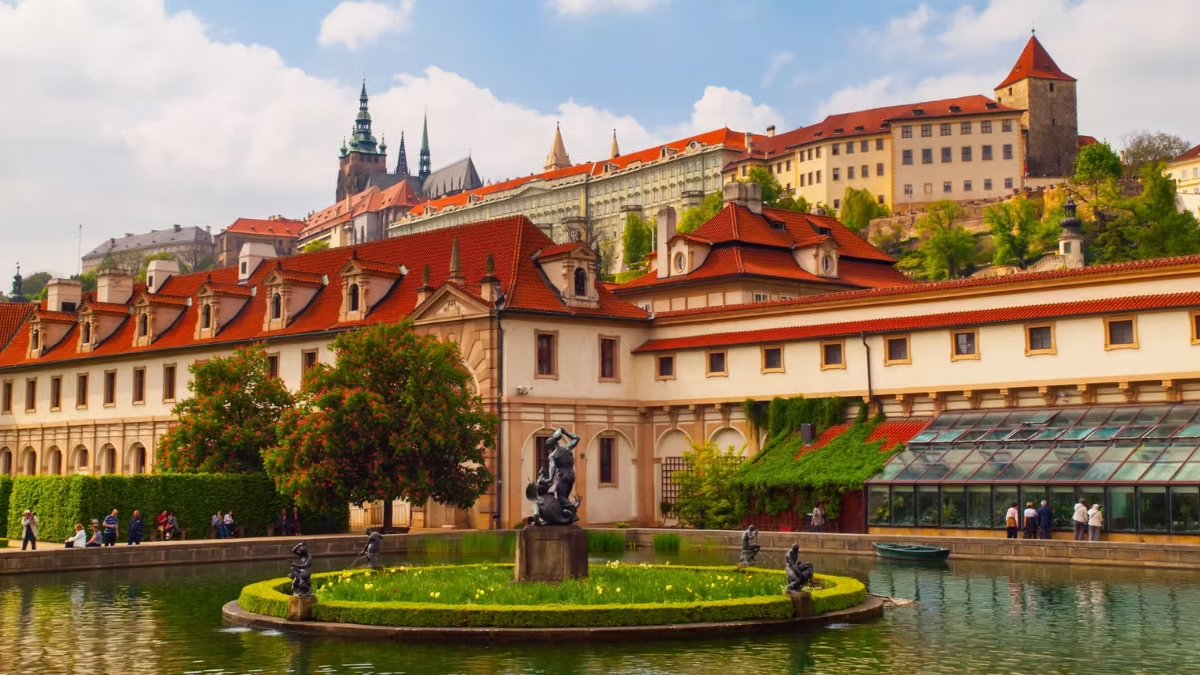
Prague Castle’s gardens are one of the most undervisited parts of the complex — a succession of terraced, formal, and naturalistic green spaces that most visitors miss entirely because they are busy in the buildings. The South Gardens alone run nearly 500 metres along the castle’s southern wall with panoramic views over Malá Strana and the Vltava. The Royal Garden is a genuine Renaissance park with a 16th-century Singing Fountain and the Summer Palace of Queen Anne. All of it is free.
Garden Overview
Prague Castle has several distinct gardens, all free to enter. The main gardens are: the South Gardens (terraced panoramic gardens along the southern castle wall, April–October), the Royal Garden (Renaissance park on the northern side, April–October), the Garden on the Bastion (year-round, 6am–10pm), and the Deer Moat (wild ravine, partially accessible April–October). All gardens are closed November–February except the Garden on the Bastion.
| Garden | Location | Season | Highlights |
|---|---|---|---|
| South Gardens | Southern castle wall | April–October | Panoramic views, Bull Staircase, Plečnik terraces |
| Royal Garden | North of castle | April–October | Singing Fountain, Queen Anne's Summer Palace, Orangery |
| Garden on the Bastion | Between 1st and 4th Courtyards | Year-round | Quiet escape, castle views |
| Deer Moat (Stag Moat) | Northern ravine | April–October | Wild woodland, tunnel walk |
South Gardens
The South Gardens are three connected terraced gardens — the Paradise Garden, the Garden on the Ramparts, and the Hartig Garden — running nearly 500 metres along the southern castle wall. They offer the finest panoramic views of Prague from any outdoor space at the castle. Enter via the Bull Staircase from the Third Courtyard or from the Na Opyši gate on the east side. Free, open April–October.
The South Gardens were established on the site of the castle’s medieval southern fortifications and were redesigned in the 1920s by Josip Plečnik — the Slovenian architect commissioned by Czechoslovakia’s first president, Tomáš Masaryk. Plečnik’s signature marks are visible throughout: monumental granite staircases, granite bowls, and a formal geometric sensibility that makes the gardens feel like outdoor architecture rather than purely natural space.
Highlights of the South Gardens:
Paradise Garden (Rajská zahrada) — the westernmost of the three, entered via the Bull Staircase from the Third Courtyard. Plečnik designed its current form in the 1920s. Contains an estimated 400-year-old yew tree that Plečnik deliberately designed the stone border to bypass. The terrace offers a broad view over Malá Strana.
Garden on the Ramparts (Zahrada na Valech) — the central and largest section, running beneath the southern face of the Old Royal Palace and the cathedral. A central terrace offers the widest panoramic view of the city — Malá Strana rooftops, Charles Bridge, the Vltava, the Old Town in the distance, Petřín Hill to the south. The Moravian Bastion at the eastern end was a favourite retreat of President Masaryk.
Hartig Garden — the smallest of the three, at the eastern end, with a Music Pavilion. Connected to the main South Gardens in the 1960s.
Entrances: Via the Bull Staircase from the Third Courtyard (next to the Old Royal Palace entrance); from the Na Opyši gate area on the eastern side; the western gate near Hradčanské Square is exit-only.
Opening hours: April–June: 10am–7pm; July–August: 10am–8pm; September: 10am–7pm; October: 10am–5pm. Closed November–March.
The South Gardens are included in your castle visit — no separate ticket needed. The Main Circuit ticket (or audio guide ticket) gives you access to the gardens via the Bull Staircase.
Royal Garden
The Royal Garden is the most historically and architecturally significant of the Prague Castle gardens. Founded in 1534 by Emperor Ferdinand I in the style of Italian Renaissance gardens, it contains the Singing Fountain, the Summer Palace of Queen Anne (the Belvedere), the Ball Game Hall, and the modern Orangery by Eva Jiřičná. Located north of the castle, accessed via Prašný most (Powder Bridge) or from the Fourth Courtyard. Free, open April–October.
Highlights of the Royal Garden:
Singing Fountain — a bronze fountain cast in 1568 by Tomáš Jaroš, positioned in front of the Summer Palace. The name comes from the musical sound the water produces as it strikes the bronze basin. It is one of the most beautiful Renaissance fountains in Central Europe.
Summer Palace of Queen Anne (Belvedere) — at the eastern end of the garden, this pure Renaissance building was commissioned by Ferdinand I for his wife Anne of Jagellon in 1538. It is considered the finest example of Renaissance architecture in Central Europe north of the Alps. The simple arcade of Ionic columns, the light stonework, and the delicate copper roof set it apart from anything else in Prague.
Ball Game Hall (Míčovna) — a late Renaissance hall used for the nobles’ sport of court tennis. The walls are covered in elaborate sgraffito decorations depicting allegorical and mythological figures. Occasionally open for exhibitions and cultural events.
Orangery — the modern greenhouse at the western end of the garden was designed by Czech architect Eva Jiřičná in 1999 as a glass-and-steel cylinder 90 metres long. It was sponsored by Jennifer Simon from Canada in memory of Olga Havlová. It stands in deliberate contrast to the Renaissance buildings nearby.
Entrance: Three entrances — two from U Prašného mostu Street on the west; northern gate near the Summer Palace. Note: During the 2026 tram track closure (21 March–17 July), the Královský letohrádek tram stop is suspended — use Prašný most stop instead.
Opening hours: April–June: 10am–7pm; July–August: 10am–8pm; September: 10am–7pm; October: 10am–5pm. Closed November–March (partially open November 1–12: 10am–4pm).
Garden on the Bastion (Na Baště)
The Garden on the Bastion is the only Prague Castle garden open year-round (6am–10pm daily). Located between the First and Fourth Courtyards, it is a small quiet garden with views up toward the castle’s northwest face — a good spot for a peaceful moment before entering the complex.
The garden sits on the site of archaeological remains including the foundations of the Church of the Virgin Mary, the very first walled structure built at Prague Castle around 880 AD. Remnants of the Romanesque-era fortifications beneath give the garden its historical significance.
Deer Moat (Stag Moat / Jelení příkop)
The Deer Moat is a long wooded ravine running along the northern side of the castle, originally used as a hunting ground for deer and then as a natural defence. It is now a wild, naturalistic park in contrast to the formal gardens. Accessible April–October via the observatory path from the Royal Garden or the Prašný most entrance. A tunnel walk through the castle connects the two halves. Note: occasionally closed for maintenance; check hrad.cz before visiting.
The Deer Moat provides the most naturalistic green experience at Prague Castle — a wooded valley in stark contrast to the formal gardens and historic buildings above. The tunnel through the castle (designed by architect Josef Pleskot) connects the two sections of the moat walk. The upper part of the moat, restored and recently reopened, offers views up to the castle walls from below.
Practical Information
Are the Prague Castle gardens free? Yes. All Prague Castle gardens are free to enter. No ticket required.
When are the gardens open? The South Gardens and Royal Garden are open April–October only. The Garden on the Bastion is open year-round (6am–10pm). The Deer Moat is accessible April–October when the Royal Garden is open.
Can I have a picnic in the Prague Castle gardens? Yes. Picnicking is permitted in the gardens. The South Gardens’ terraces are particularly pleasant for an outdoor break with views. Food and drink are not permitted inside the historical buildings.
Are the gardens accessible by wheelchair? The Royal Garden is the most accessible, with flatter paths. The South Gardens have terraced sections with stairs that are more challenging. Check hrad.cz for current accessibility routes.
Frequently Asked Questions
Are Prague Castle gardens free?
Yes. All Prague Castle gardens are free to enter.
What are the best gardens at Prague Castle?
For panoramic views: the South Gardens (Garden on the Ramparts). For historical and architectural interest: the Royal Garden (Singing Fountain, Queen Anne’s Summer Palace). For a year-round quiet green space: the Garden on the Bastion.
When do Prague Castle gardens open?
The South Gardens and Royal Garden open in April and close in October/November depending on the section. The Garden on the Bastion is open year-round, 6am–10pm.
How do I get to the South Gardens?
Via the Bull Staircase from the Third Courtyard (next to the Old Royal Palace entrance) or from the Na Opyši gate on the eastern side.
How do I get to the Royal Garden?
Via U Prašného mostu Street (west side). During the 2026 tram closure (21 March–17 July) the Královský letohrádek tram stop is suspended — alight at Prašný most instead.
