
Prague Castle — What to See Inside
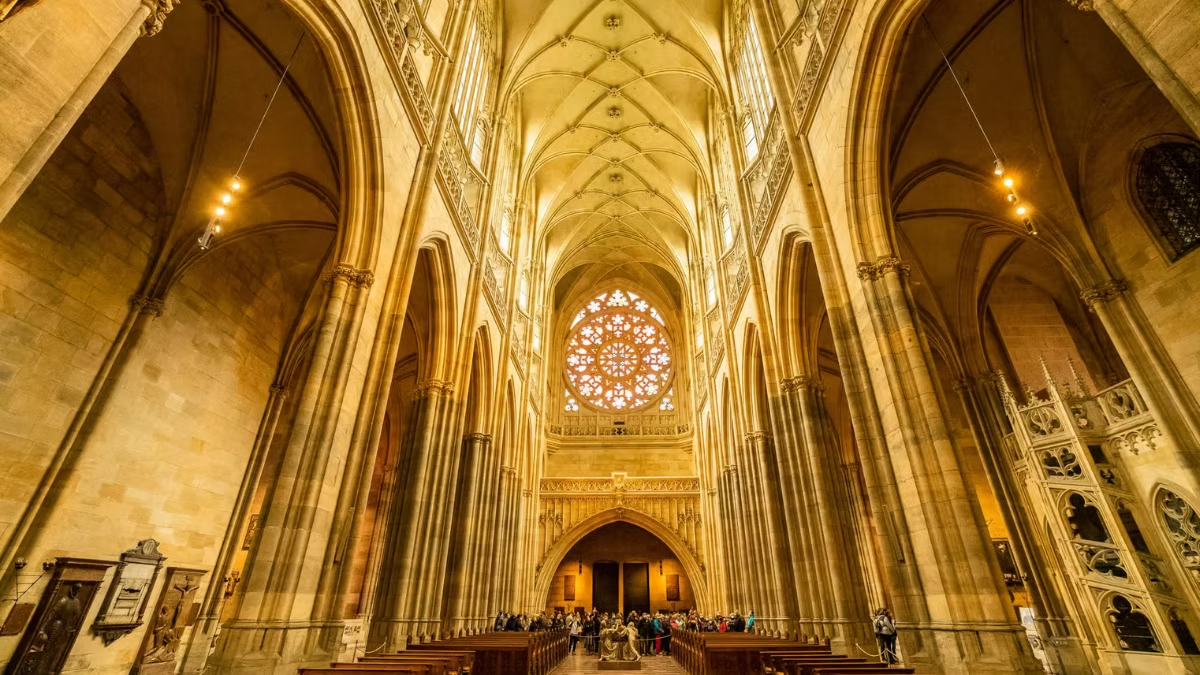
Prague Castle’s most important experiences are inside its buildings, not visible from the courtyards. The scale of St. Vitus Cathedral, the political weight of the Old Royal Palace’s Defenestration chamber, the intimacy of Golden Lane, the extraordinary private art collection at Lobkowicz Palace — none of these can be appreciated from outside. This guide covers everything worth seeing inside the castle complex, building by building, with what to look for in each.
Overview: What Requires a Ticket vs What Is Free
The paid Main Circuit covers St. Vitus Cathedral, Old Royal Palace, St. George’s Basilica, and Golden Lane (450 CZK adult). Lobkowicz Palace is a separate private ticket (approx. 290 CZK). The South Tower is a separate add-on (200 CZK). The courtyards, castle exterior, and Golden Lane after closing time are free.
| Site | Ticket Required | Circuit |
|---|---|---|
| St. Vitus Cathedral | Yes | Main Circuit |
| Old Royal Palace | Yes | Main Circuit |
| St. George's Basilica | Yes | Main Circuit |
| Golden Lane (house museums) | Yes during hours / Free after 5pm (summer) | Main Circuit |
| Lobkowicz Palace | Yes (separate) | Private ticket |
| Great South Tower | Yes (add-on) | Separate ticket |
| Story of Prague Castle | Yes | Permanent Exhibitions |
| Prague Castle Picture Gallery | Yes | Permanent Exhibitions |
| Castle courtyards | No | Free |
| Gardens | No | Free (seasonal) |
St. Vitus Cathedral
St. Vitus Cathedral is the centrepiece of the castle complex and the most important church in Czech history. The highlights are: the Alfons Mucha stained-glass window, the Chapel of St. Wenceslas, the royal crypt, the baroque silver tomb of St. John of Nepomuk, and the Golden Gate mosaic on the south facade. Allow 45–60 minutes. Closes at 5pm summer / 4pm winter; opens noon on Sundays.
Construction began in 1344 under Emperor Charles IV and was not completed until 1929 — a building period of nearly 600 years. The cathedral is consequently a palimpsest of Gothic and Neo-Gothic architecture, from the medieval eastern apse to the 20th-century western facade.
Key things to see inside:
Alfons Mucha stained-glass window — on the north wall of the nave, installed in 1931. The celebrated Czech Art Nouveau painter designed it in deep blues, golds, and reds, depicting Saints Cyril and Methodius and scenes from their missionary work in the Slavic lands. It is one of the most recognisable artworks in Central Europe.
Chapel of St. Wenceslas — the most ornate space in the cathedral, built over the tomb of the patron saint of Bohemia. The lower walls are encrusted with approximately 1,300 semi-precious stones, and the upper walls are covered in 14th-century frescoes of Christ’s passion and scenes from the life of St. Wenceslas. Access to the door of the Crown Chamber is within this chapel (the chamber itself is not open to the public).
Royal Crypt — accessible via a staircase in the nave. Contains the remains of several Bohemian kings and queens including Charles IV, Wenceslaus IV, Rudolf II, and the Habsburg Emperor Ferdinand I.
Tomb of St. John of Nepomuk — the most visually spectacular object in the cathedral: a massive baroque silver tomb (approximately 20 tonnes of silver) in the south choir. St. John of Nepomuk, the first martyr of the Seal of Confession, was thrown from Charles Bridge in 1393 on the orders of King Wenceslaus IV.
Golden Gate mosaic — visible from the Third Courtyard and accessible from inside the south transept: a 14th-century Venetian-style mosaic of the Last Judgement above the main ceremonial entrance, one of the oldest and best-preserved mosaics north of the Alps.
Great South Tower — separate add-on ticket (200 CZK). 287 spiral steps to the viewing gallery with panoramic views over Prague. Opens at 10am. Not included in the Main Circuit ticket.
Buy This TicketOld Royal Palace
The Old Royal Palace is the medieval seat of the Bohemian kings. The centrepiece is the Vladislav Hall — a vast late-Gothic vaulted room where knights jousted on horseback in the 15th century. Adjacent is the room where the Third Defenestration of Prague (1618) took place. Allow 30–45 minutes.
The Old Royal Palace is the most historically significant building most visitors walk through too quickly. The rooms are largely bare stone, which — without context — can feel underwhelming. With context, they are extraordinary.
Key things to see inside:
Vladislav Hall — completed 1493–1510 by architect Benedikt Ried, the hall is 62 metres long, 16 metres wide, and 13 metres high, with a remarkable late-Gothic vaulted ceiling whose ribs twist and interweave in patterns more reminiscent of Renaissance decoration than medieval Gothic. Knights rode on horseback up the Riders’ Staircase (visible at the hall’s eastern end) to joust inside. Coronations, royal elections, and state events still take place here.
Riders’ Staircase — the massive spiral staircase adjacent to the Vladislav Hall was designed wide enough for fully armoured knights on horseback to ride into the hall for tournaments. It is a piece of medieval engineering that has no parallel in Central Europe.
Defenestration room (Bohemian Chancellery) — the room in the Louis Wing where, on 23 May 1618, Protestant Czech nobles threw two Catholic imperial governors and their secretary out of the window — an act that triggered the Thirty Years’ War. The window itself is still there. Most visitors walk past without realising what room they are in. A small plaque identifies the event.
Old Parliament room — the room where the Bohemian Diet (parliament) met in the medieval period. The coats of arms of the Bohemian nobility line the walls.
St. George’s Basilica
The Basilica of St. George is the oldest surviving church building at Prague Castle, founded in 920 AD by Prince Vratislaus I. Its Romanesque interior — plain stone walls, round arches, a barrel-vaulted nave — is a stark contrast to the Gothic cathedral and is worth seeing precisely for that difference. Allow 15–20 minutes.
The basilica’s exterior is a distinctive Baroque red facade added in the 17th century; the interior is purely Romanesque. It contains:
Tomb of St. Ludmila — Bohemia’s first Christian martyr (grandmother of St. Wenceslas), buried in the north chapel. She was strangled by her daughter-in-law Drahomíra in 921. 12th-century frescoes — fragments of the original Romanesque paintings are visible in the presbytery, among the oldest surviving frescoes in Bohemia. Tomb of Prince Vratislaus I — the basilica’s founder is buried in the nave. Double staircase — the unusual split staircase leading up to the choir is an architectural feature unique in Bohemia.
Golden Lane
Golden Lane is a narrow street of tiny, brightly coloured medieval cottages built into the northern castle wall in the 16th century. During opening hours it requires a paid ticket; after 5pm in summer (4pm in winter) it is free. The highlights are: the armour and weapons display, the reconstructed alchemist’s laboratory, and No. 22 — the house where Franz Kafka briefly lived from 1916 to 1917.
Golden Lane is 13 tiny cottages originally built for the castle guard, later inhabited by goldsmiths, craftspeople, and artists. Each house has been turned into a small museum or period display.
Key things to see:
Armour and weapons display — one of the cottages contains a ground-floor display of medieval armour, swords, crossbows, and castle defence equipment. One of the most child-friendly exhibits at the castle. Alchemist’s laboratory — accessed through an exceptionally low doorway, the reconstructed laboratory complete with tools, vessels, and period atmosphere is one of the most atmospheric spaces on the lane. No. 22 (Kafka’s house) — the small blue cottage where Franz Kafka lived from November 1916 to March 1917, writing some of the stories later collected in A Country Doctor. Today it sells Kafka-related books. Daliborka Tower — at the eastern end of the lane, the 15th-century tower served as a prison. The legend holds that the first prisoner, a knight named Dalibor of Kozojedy, learned to play the violin in captivity and his music drifted out over the castle, attracting crowds. Accessible with the Main Circuit ticket.
Lobkowicz Palace (Separate Ticket)
Lobkowicz Palace is the only privately owned building at Prague Castle and holds one of the finest private art collections in Central Europe. The audio guide is narrated by members of the Lobkowicz family. Highlights include original Beethoven and Mozart manuscripts, and paintings by Bruegel, Canaletto, and Velázquez. Separate ticket required (approx. 290 CZK); tickets collected at the Lobkowicz cash desk only.
See our dedicated guide: Prague Castle & Lobkowicz Palace Combo Ticket
Buy This TicketThe Prague Castle Picture Gallery
Located in the Second Courtyard, the Picture Gallery holds a selection of Baroque and Mannerist paintings from the collection of Emperor Rudolf II — the most important art collector to inhabit the castle. Separate Permanent Exhibitions ticket required.
Story of Prague Castle Exhibition
An extensive permanent exhibition in the basement of the Old Royal Palace tracing the history of the castle from prehistoric times to the 20th century. Includes scale models of the castle’s evolution, archaeological finds, royal artefacts, and displays on the communist period. Separate Permanent Exhibitions ticket required.
Practical Information
- Main Circuit ticket: 450 CZK adult / 300 CZK reduced / 950 CZK family. Covers St. Vitus Cathedral, Old Royal Palace, St. George’s Basilica, and Golden Lane.
- South Tower: 200 CZK separate add-on; opens 10am.
- Lobkowicz Palace: Approx. 290 CZK separate ticket; tickets collected at the Lobkowicz cash desk only (not at castle information centres).
- Permanent Exhibitions circuit: 300 CZK; includes Picture Gallery, Story of Prague Castle, Castle Guard Exhibition.
- Opening hours: 9am–5pm summer / 9am–4pm winter. Last entry 15 minutes before closing.
- St. Vitus Cathedral: Opens at noon on Sundays.
Frequently Asked Questions
What is the best thing to see inside Prague Castle?
St. Vitus Cathedral — particularly the Mucha stained-glass window, the Chapel of St. Wenceslas, and the royal crypt. The Vladislav Hall in the Old Royal Palace is the other highlight.
Can you go inside all the buildings at Prague Castle?
With the Main Circuit ticket you access four buildings: the Cathedral, Old Royal Palace, St. George’s Basilica, and Golden Lane. Lobkowicz Palace requires a separate ticket. Some buildings (presidential apartments, state rooms) are not open to the public.
Is St. Vitus Cathedral inside Prague Castle?
Yes. Many visitors search for it as a separate city attraction. It is inside the castle complex in the Third Courtyard.
